
Dynamics shift in Greeks’ favour as banks eye next phase from a position of strength
Having ridden a wave of demand and rerating to help normalise their balance sheets and funding, Greek banks now find themselves positioned closely alongside their European peers. On 17 June, Crédit Agricole CIB brought together Alpha Bank, National Bank of Greece, Piraeus Bank and Moody’s at the Benaki Museum of Greek Culture, Athens, to share their views on the outlook for the country’s banks.
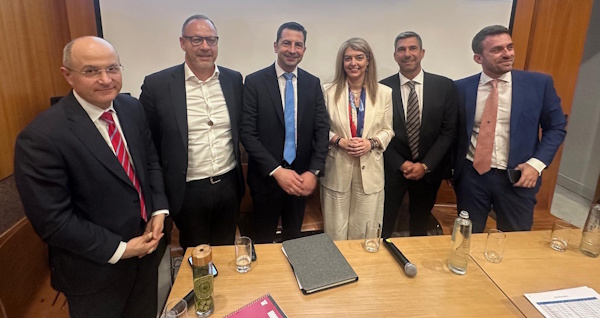
Pictured, left to right: Valentin Marinov, Crédit Agricole CIB, Vincent Hoarau, Crédit Agricole CIB, Dimitrios Spathakis, Piraeus Bank, Elena Koukoutsidi, Alpha Bank, Nondas Nicolaides, Moody’s, Vassilis Kotsiras, National Bank of Greece
You can download a pdf version of this article here.
Vincent Hoarau, Head of FIG Syndicate, Crédit Agricole CIB: The Greek banks have been one of the most compelling rerating stories in euro financials over the past three years. We know where the Greek landscape is in Tier 2 — where we have meanwhile just crossed some key barriers with names like PKO at 130bp and BCP at 133bp. Elena, what do you think is left on the table in terms of value for investors, and more generally speaking, on the agenda for Greek banks?
Elena Koukoutsidi, Director, Treasury, Alpha Bank: It definitely has been a remarkable journey. But rather than revisiting the past, let’s focus on the present. Asset quality has improved massively, our liquidity and capital positions are robust, and we are also talking about sustainably high profitability. If for a moment you were to scratch out the label above our balance sheet, and compare it with other European banks, you wouldn’t see much difference — we stand very close to their levels. So, at least to my mind, fundamentals already justify higher ratings — but the sovereign cap is binding.
Coming to spreads, I will not go back to ancient history, when we first started issuing following the crisis, but I will go to 2024. Then, a six non-call five bond for a Greek bank like us was issued at 240bp. Last year, we printed a similar transaction at 90bp. What I’m trying to say is that the convergence basically has already taken place. We have moved a lot, and this is related to both fundamentals and the fact that we are part of the investment grade territory. We’re priced as such, so even incremental rating upgrades from here would likely have limited additional impact on pricing. To sum up, I would say the rerating story is not over but clearly is entering a more steady pace.
Hoarau, Crédit Agricole CIB: Nondas, we have seen a dramatic reduction in non-performing loans. What are your thoughts on how this has developed?
Nondas Nicolaides, Vice President — Senior Credit Officer, Moody’s: We have seen a significant improvement in the underlying financial fundamentals of Greek banks over the last five to six years. On our side, we took the strategic decision to be forward-looking in our assessment. We knew that a clean-up was coming, we knew that some of the transactions would be transformational for the balance sheets of Greek banks, so in our rating discussions and decisions, we tried to be as forward-looking as possible.
Take, for example, the trajectory of NBG’s baseline credit assessment (BCA) — which is like the anchor rating upon which all its other ratings depend. Five years ago, in September 2021, it was B3 — six notches lower. So within a timespan of five years, we upgraded by an average of more than one notch a year. The sovereign was also being upgraded, and that is an important reference for the banks’ ratings.
We are now at a point where we have reached, let’s say, a more normalised state. Forward-looking assessments will therefore not play such a great role as was the case a few years back.
There are still some pockets of risk — which we can focus on later — so we could say that there are some things yet to be done before Greek banks are fully aligned with European credits, with their spreads being at the same level.
Hoarau, Crédit Agricole CIB: Dimitrios, the ECB hiked rates last week, by a quarter of a point. Meanwhile, GDP growth is challenged in some part of Europe. Greek banks entered 2026 with a strong capital generation and improving cost structures. How are you now positioning the revenue mix — fee income, lending growth, cost discipline — to cope with the new environment?
Dimitrios Spathakis, Head of Treasury, Piraeus Bank: The ECB did indeed hike, as was widely expected. Regarding GDP, I would make one observation: Greek GDP continues to outperform Europe. In fact, we expect our GDP to this year grow at double the rate of the rest of the Eurozone. This will provide some very positive technical supports for our business. Focusing on the funding side, the fact that the economy continues to outperform will continue to generate liquidity on the ground, increased deposits, and support inflows to Greek asset managers. All this is conducive to our funding business.
Piraeus Bank recently announced its five year, 2030 business plan. We did so just after the start of the US-Iran conflict, and despite that, we have matched, and in some lines are running slightly ahead of what we promised the market.
In terms of revenue mix, we look to diversify our top line as much as possible. We decided at the end of last year to boost our fee-contributing top line item with the acquisition of Ethniki Insurance. We expect to generate more than 25% of our revenues from fees — which means that our fees will account for around 1% of our total assets. This is best in class in Greece, and close to the best performers in Europe.
Turning to cost-to-income, we have a history of cost optimisation. Piraeus Bank is a very large institution that is the amalgamation of many smaller banks, so we’ve had to be very efficient in terms of how we run it. We are currently running at a cost-to-income ratio of the 35% area, which compares to a European average of 55%. So we are already very cost efficient, and in fact we aspire to bring this down to the low thirties.
Then we have net interest income: Piraeus makes around €2bn in terms of NII. We expect this to grow to €2.5bn in the next five years. And in fact, there is an upside risk for this year, simply because the ECB has been raising rates, the short term part of the curve has already moved over the last three months, so there is going to be some nice pass-through in terms of our loan portfolio.
In terms of loan growth, again, we expect the loan portfolio to grow quite substantially, from €37bn at end-2025 to €55bn in 2030, the best part of which should come from our corporate banking portfolio, in areas such as energy, hospitality, tourism, and shipping.
We believe this is a nice diversification and a nice growth story.

Hoarau, Crédit Agricole CIB: When it comes to regulatory capital funding, all the Greek banks have built up their MREL stacks with senior preferred and Tier 2. Everything has been very, very well received by the market. Vassilis, where do you stand with regards to completion of your major requirements?
Vassilis Kotsiras, Head of Strategic ALM and Wholesale Funding, National Bank of Greece: All the Greek banks are currently running with a long term surplus of more than 2%, even if it varies from bank to bank, and over time. On our side, we have had this surplus of CET1, which came up a lot in discussions with Moody’s, because of their methodology. But now we are on a path towards normalising our CET1 level, and overall we are on a growth trajectory.
This normalisation is coming from three basic pillars. One is organic growth and demand for new loans, which is increasing. The second is that we want to be best in class in terms of shareholder renumeration. We have been the bank giving the most so far, with a 60% dividend pay-out ratio from the bottom line, but furthermore, a special dividend this year. And thirdly, acquisitions, to push for non-organic growth. All these three pillars point in one direction, namely utilisation of excess CET1.
Regarding issuance, we will need to do so in order to continue having an MREL buffer that supports all our targets. We had been the bank yet to issue an AT1, but we did so this year — the special dividend explains the rationale behind it.
You really need at least two more years in order to see how the Greek banks will be positioned in the capital markets. This is because we are all currently seeing an evolution in our shareholder structure and also debt investors. For example, three years ago the financial stability fund held 42% of NBG, but today, 50% of our shareholders are US funds. It’s night and day what they expect. And while some investors expect a much higher dividend strategy, others expect expansion. So we aim to keep all options open for the bank, safeguarding a future that is appropriate for NBG as a national champion. That will also have implications for how we further develop our strategy towards the debt capital markets going forward.
Koukoutsidi, Alpha Bank: I agree with Vassilis. And I would like to add that the overall issuance pipeline from the Greek perimeter is clearly more manageable than it was three or four years ago, when we were starting the build-up phase and were frontloading issuances. So on that front, things are much better. At Alpha Bank, we stand considerably above our MREL target, and as far as this year is concerned, we have just one more transaction in mind, which is the refinancing of a bond that has a call in 2027. Basically this is the way forward: we will be focusing more on refinancing transactions, but adding some incremental new ones, as balance sheets are growing, RWAs are increasing, we are particularly active on the M&A front, and we want to maintain the dividend pace indicated to shareholders.
Hoarau, Crédit Agricole CIB: Dimitrios, would you like to complete the picture?
Spathakis, Piraeus Bank: It’s a similar picture for us.
Having met our MREL requirements and having filled the Tier 2 and the AT1 buckets, the majority of our transactions going forward will be refinancing. So if you look at our redemption profile, you will have a good idea of what to expect from us. I expect there to be some additional supply only to cover for any extra headroom as risk assets grow. We all have aggressive growth assumptions that mean our RWAs will grow, so the denominator will increase, and there may be some space for extra Tier 2, for extra senior, etc. But this is manageable. The most important thing is that, as Elena said, the difficult part — when we all had to bring billions of supply year in, year out of AT1, Tier 2, seniors, etc, and were all knocking on the doors of the same investors for the same instrument — this part is behind us, and now we are facing the world with more modest needs, but most importantly, with more investors coming in. In the past, it was mainly UK hedge funds and asset managers. Then we had Italians and the French, and now we see the Nordics, pension funds, insurance companies, etc. In the past couple of years we even saw the return of top tier investors who hadn’t invested in any Greek assets since 2015. That’s a breakthrough and will make a big difference going forward, so I’m quite optimistic when it comes to future supply.
Hoarau, Crédit Agricole CIB: Nondas, after the compelling story that we’ve been hearing, what is required for the next upgrade?
Nicolaides, Moody’s: There are a few important things that we need to see before we consider further bank rating upgrades. The most important factor is the sovereign rating, since it currently constrains most of the bank ratings. Greek banks are highly exposed to the sovereign on the asset side of the balance sheet, whether through Greek government bonds, deferred tax credits, or government guarantees. For us to be able to rate the bank higher than the sovereign in terms of the baseline credit assessment, that exposure needs to be contained, needs to be at a low level. The fact that all the banks are highly exposed to the sovereign means that the sovereign rating is actually a cap in terms of the BCA. Currently the sovereign rating is Baa3, with a stable outlook. I’m not the sovereign analyst, but I would think there is potential, and a good chance for either a positive outlook or an upgrade going forward, given the debt trajectory of the country, and the growth trajectory, too.
But there are two or three other things that we need to see that would be supportive of potential bank rating upgrades. There is the quality of capital — a further reduction of the DTC component within the capital structure would definitely be positive. A further reduction in repossessed or, let’s say, non-yielding assets sitting on the balance sheet would also be supportive. And if the type of profitability that we see right now is sustained going forward. The other important element that we’re closely monitoring is the formation of new non-performing exposures (NPEs). If this were to remain at very low levels — as is the case right now — it would suggest to us that the quality of new lending provided in the last few years, mainly on the corporate side, is solid. This is paramount to our analysis, because it would mean that asset quality going forward will further improve because of the denominator effect and the loan growth plans that the banks have.
That’s an overview of the important things that we are looking at.
Kotsiras, National Bank of Greece: If I may add a point — Moody’s methodology has been one of the most transparent amongst the rating agencies during the last years and the communication between our bank and Moody’s analysts have been of great assistance. In 2022 when we reopened the market, we took the decision to be rated only by Moody’s on seniors and Tier 2, because we took the view that Moody’s would have been the first to upgrade Greek banks to investment grade, and when that happened after two-and-a-half years, with the Hellenic Republic rating being the lowest among the other major rating agencies, we found our bonds to be at the same time eligible for index eligibility in the market.
It is one of the most constructive cooperations we are having.
Hoarau, Crédit Agricole CIB: Regarding secured funding, you all have covered bond frameworks. Given where covered bond spreads are on an absolute basis, and the differential between covered and senior, what are you waiting for?
Koukoutsidi, Alpha Bank: It’s going to take place at some point! But you must consider the following facts. The loan-to-deposit ratios of Greek banks are somewhere between 70% and 80%. Ours is among the highest, and still we are not considering issuing a covered bond. There is no immediate funding pressure on the balance sheet. On top of that, we all need to continue issuing to maintain our MREL buffers, which implies that senior issuance is must-do and it adds both to liquidity, tenor, helping on the NSFR. We do have retained covered bonds, which can be placed in the market. But these are used in short dated secured transactions at much more appealing levels.
The last fact relates to the Greek mortgage market — whose growth is rather anaemic. We would love that to be increasing, but the reality is that net supply remains only marginally positive, so we don’t have a growing cover pool that would give us a reason to consider issuing.
For the last couple of years, we have been debating whether covered bonds should be included in the following year’s planning, but we quickly come to the conclusion that they won’t be included.
Kotsiras, National Bank of Greece: I would say that we are getting closer to the point where we should reassess covered bond issuance, as there are many benefits to the product.
In terms of pricing, we see indicative quotes for a five year of around 35bp, while for senior in the same tenor it is 85bp — this is good. Two years ago, when we had the European Covered Bond Council conference in Athens, Italian banks issued their covered bonds at 70bp and senior at 100bp. At that point, the market had not yet fully recovered after the period of ECB dominance. We are now at much better levels. Italian banks are now in the low 30s in five years, with UniCredit having also recently issued a dual-tranche, three and seven year. The indicative 35bp level we have been shown probably reflects the fact that Greek banks have not issued yet. Somebody will have to open the market for the actual level to become clear.
Regarding funding needs, Elena’s comments make sense. But at NBG, for example, we are monitoring how the interbank lending is developing. Over two years, our excess cash position has been either directed to bonds or to the fee business of the asset management, or to expansion. We have needed to put our liquidity to work and we are starting to see things normalise, although we still have an elevated LCR at 235%.
The covered bond has a further benefit, which is to help meet certain investors, in areas like Germany and Scandinavia. Looking at the books of other peripheral banks’ covered bonds, they have a very big participation of DACH and Nordic investors, 40%-55% — in our seniors, we see much more limited demand from these regions, 10%-15%.
Koukoutsidi, Alpha Bank: Picking up, though.
Kotsiras, National Bank of Greece: Picking up, yes, but I think that if you approach these investors with what is their bread and butter, by offering them a covered bond, then they might realise that our senior paper is IG, and also the Tier 2 is IG, so maybe they can start investing to the whole capital stack.
So it is hard to say. For NBG, publicly-issued covered bonds would definitely not be above €1bn of our liabilities. At the same time, we would need to become a consistent issuer, i.e. tapping the market every 18 to 24 months, which we haven’t done in the past. I don’t think it’s 2026 business, but you never know. In 2027, I hope we have that opportunity.
Koukoutsidi, Alpha Bank: As mentioned, we don’t have a significant mortgage lending increase, so the question from investors in such countries will probably be, OK, I see this first covered bond issuance, but what are your plans for a follow-up? How would you answer that? Reducing retained issuance and going to the wholesale funding market? That is my point. We need to see some positive developments coming from the mortgage market before we actually decide to be a consistent issuer in the covered bond market.
Kotsiras, National Bank of Greece: One issue has been that mortgages have been priced expensively in Greece due to the NPE generation of the crisis. Currently we see lower spreads on mortgages as we have seen already to corporate and SMEs. There are developments we can be proud of in Grece, but there are other areas where we still need to catch up with the rest of Europe.
Our mortgage portfolio has maintained a steady level, and in the next phase, I would expect to see it gradually increase. But if you have €6.5bn of mortgages, using €1.2bn of them simply to have two issues in the market is feasible. When we did that in 2009 in issuing the first covered bond, for €1.5bn, everybody was saying, why did you do it? NBG had massive liquidity. Then this €1.5bn held up for seven years till we exited the crisis. So as we say in the debt capital markets, do it when you don’t need it, because when you will need it, you won’t be able to do it. So we will see.
Hoarau, Crédit Agricole CIB: Let me finish with a geopolitical question. If I look at where Greece sits geographically, it could be seen as amazing how credit spreads have performed. Dimitrios, what’s your takeaway from that?
Spathakis, Piraeus Bank: We measure geopolitical risk, of course. We’ve been stress-tested by the ECB and have our own risk models. But rather than discussing geopolitical risk theoretically, we can look at what has happened in the actual geopolitical risk that is live as we speak. Hopefully, the situation is getting better, but we are already three months into the US-Iran conflict, and in this geopolitical crisis Greek banks’ bonds have performed similarly to those from the rest of Europe. We have previously been seen as the very definition of a high beta region, but credit spreads have been amazingly resilient. We have even seen primary supply out of Greece — the brave folk sitting next to me have issued very successfully.
There are a few factors that have been very supportive. One is a bit technical, and not that obvious, but in Greece there is a very well developing asset management pool: Greek asset managers, the banks, there is a very strong high net worth individual pool, private banking, as well. This amounts to a very strong and consistently developing pool that has been very conducive to our bonds. You know, when you have a non-domestic buyer being a part of our books, they may forget about it the next day, and focus on the next trade. But Greek asset managers, in case they receive a bit less than what they wanted, it is more likely they are going to be there the next day, knocking on the door, trying to bid the bonds. This is very important for the secondary performance of our bonds, and very important for the support we get in the primary books.
So geopolitical risks are there, but in terms of investors, this is not really a discussion item.

Reception at the Benaki Museum of Greek Culture, Athens